
Henderson, Nevada, has one of the more unusual origin stories of any major city in the state. It grew out of a World War II magnesium operation and nearly disappeared after the war. Over time, Henderson grew from a wartime industrial town into Nevada’s second-largest incorporated city on the southern side of the Las Vegas Valley. Master-planned communities expanded across the city as the population grew, while water reuse and desert conservation became increasingly important in the Mojave Desert.
Some of the most interesting Henderson facts are easy to miss. Water Street traces its name to an industrial water pipeline. Black architect Paul Revere Williams designed housing for workers during World War II. Nearby Sloan Canyon contains more than 300 rock-art panels with about 1,700 individual designs, and wastewater ponds eventually became one of Southern Nevada’s notable bird habitats.
These 27 facts explore Henderson’s history, geography, growth, desert environment and modern identity, along with some local trivia that may surprise even longtime residents.
Table of Contents
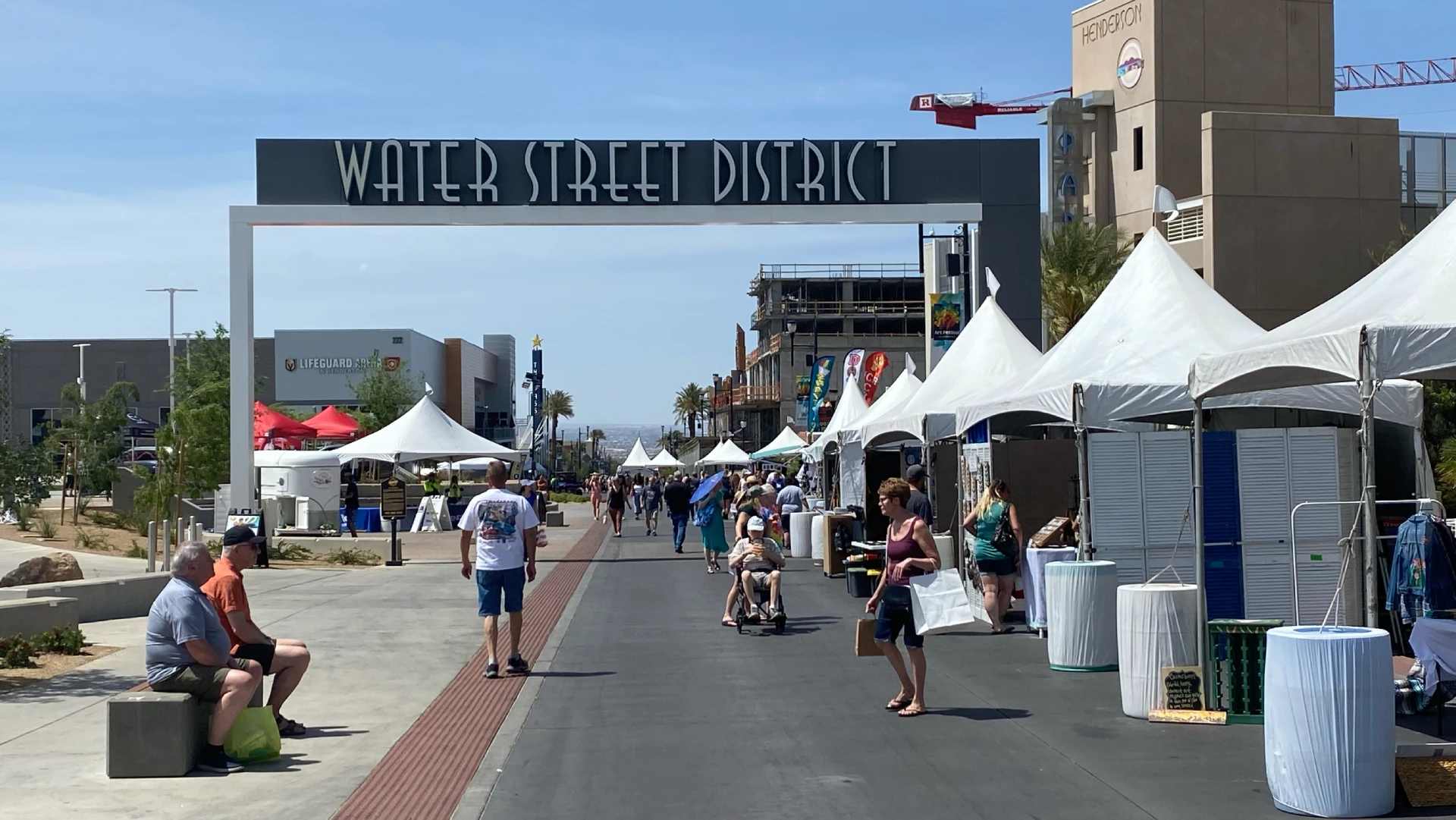
Photo by Ron Mader via Flickr, CC BY-SA 2.0.
Weird and Surprising Henderson Facts
Some of Henderson’s more unusual stories are hidden in places that now seem ordinary. A downtown street traces its name to wartime infrastructure, a contractor involved in the city’s beginnings later worked on two famous entertainment landmarks, and even the desert around Henderson has a few surprises of its own.
1. Water Street was named after a pipeline to the Basic Magnesium plant
Water Street is now the center of Downtown Henderson, but its name goes back to the city’s industrial beginnings. The street was named for the water pipeline used to pump water to the Basic Magnesium, Inc. plant during the development of the original townsite.
The Water Street corridor became Henderson’s commercial and civic center, and City Hall now stands along Water Street in Downtown Henderson. The name comes directly from the water infrastructure that supported the wartime plant and the community that grew around it.
2. A contractor that helped build early Henderson later worked on Disneyland and the Dunes Hotel
McNeil Construction built the Basic Magnesium plant that helped give rise to Henderson during World War II. The City of Henderson’s historical walking-tour material notes that the company later built Disneyland and the Dunes Hotel.
That gives early Henderson an unexpected connection to two very different chapters of Western entertainment history. Disneyland opened in Southern California in 1955, while the Dunes became one of the best-known early resorts on the Las Vegas Strip.
3. The Memphis Belle and its original crew marked a major milestone at Basic Magnesium
In July 1943, Basic Magnesium reached a full-production capacity of 112 million pounds of magnesium per year. The B-17 bomber Memphis Belle and its original crew commemorated the occasion, according to the City of Henderson’s historical records.
The connection was fitting. Magnesium from the Henderson plant was used for wartime needs that included aircraft parts and ammunition, making the city’s industrial output part of the broader American war effort.
4. Tarantulas can appear on Sloan Canyon trails during fall mating season
Tarantulas spend much of the year underground, so hikers around Henderson may never see one. Fall is different. The Bureau of Land Management (BLM) says male tarantulas become more visible during mating season as they move through Sloan Canyon looking for females.
That can put the large spiders on or near hiking trails. BLM describes seeing one in fall as something visitors should consider lucky rather than alarming.
5. Henderson has a three-acre cactus garden with more than 300 plant species
The Botanical Cactus Garden at the Ethel M Chocolates factory covers three acres in Henderson and contains more than 300 plant species. The collection includes desert-adapted plants such as giant saguaros and ocotillos, along with cacti, succulents, trees and shrubs from the American Southwest and other dry regions of the world.
Ethel M describes it as Nevada’s largest cactus garden. The garden sits next to the company’s Henderson chocolate factory in the Mojave Desert.
Henderson History and Industrial Facts
The community that became Henderson grew around one of the largest industrial projects in Southern Nevada during World War II. Basic Magnesium, Inc. brought thousands of workers to the desert, created an urgent need for housing and services, and shaped the city long after wartime magnesium production ended.
6. World War II helped create the community that became Henderson
Henderson did not grow gradually from an older Nevada town. Its modern origins date to World War II and the construction of the Basic Magnesium, Inc. plant. Groundbreaking for the plant took place in September 1941, and construction of the Basic Townsite began in February 1942 as workers and their families arrived in Southern Nevada.
Housing, schools, churches and shops followed as the new community took shape around the plant. Henderson would not officially incorporate until 1953, but the wartime settlement established the foundation of the city that exists today.
7. Henderson was home to the world’s largest magnesium plant
Basic Magnesium, Inc. built what Clark County describes as the world’s largest magnesium plant. Workers produced more than 160 million pounds of magnesium for the World War II effort, including material used in aviation. At its peak, the plant employed about 14,000 workers in the Henderson and Boulder City area.
The scale of the operation transformed the surrounding desert in a remarkably short period. The City of Henderson says almost 15,000 people came from across the country to work at the plant, creating an immediate demand for housing and public services.
8. Henderson was named for former U.S. Senator Charles B. Henderson
The city takes its name from Charles B. Henderson, a former U.S. senator from Nevada. In 1944, a new post office serving the Basic Townsite was named in his honor, and the community’s name changed from Basic to Henderson.
The distinction matters because some accounts have incorrectly identified Henderson’s namesake as James C. Henderson. Official City of Henderson records identify Charles B. Henderson as the person for whom the city was named.
9. Paul Revere Williams designed housing for Black workers in wartime Henderson
Architect Paul Revere Williams designed Carver Park in 1943 to house Black workers and their families who had come to work at Basic Magnesium. The segregated community included 324 housing units, along with a community center and a school.
Williams became one of the most prominent Black architects in American history, with a career that included homes, public buildings and major commercial projects. His work at Carver Park is an important part of Henderson’s wartime history and the story of the workers who helped build the early community.
10. Women who worked at Basic Magnesium became known as “Magnesium Maggies”
Women who worked at the Basic Magnesium plant during World War II became known as Magnesium Maggies. They drove forklifts, handled magnesium ingots, operated machinery and worked around molten metal while many men were serving in the military.
Clark County credits war worker and researcher Irene Rostine with coining the term “Magnesium Maggie.” Henderson now has a public sculpture on Water Street honoring the women who worked at the plant.
11. Henderson nearly disappeared after World War II
When wartime magnesium production ended, Henderson lost much of the industry that had created the community. By 1947, most of Basic Magnesium’s roughly 14,000 workers had moved away, school enrollment had fallen by about two-thirds, and well over half of the townsite houses were vacant.
The federal War Assets Administration even offered Henderson for sale as war-surplus property. Nevada lawmakers intervened, and Governor Vail Pittman signed legislation on March 27, 1947, allowing the Colorado River Commission of Nevada to purchase the industrial plants. The action helped keep Henderson from disappearing with the wartime operation that had created it.
12. Henderson and Boulder City share Nevada’s World War II Heritage City designation
The National Park Service jointly designated Henderson and Boulder City as Nevada’s American World War II Heritage City. The federal program recognizes communities that made significant contributions to the American home front during the war.
Only one American World War II Heritage City designation is allowed for each state or territory. Nevada’s designation recognizes Henderson’s magnesium production along with Boulder City’s role in protecting Hoover Dam and supporting wartime activity in Southern Nevada.
13. The 1988 PEPCON explosion was tied to the Space Shuttle and missile programs
On May 4, 1988, a series of explosions destroyed the Pacific Engineering and Production Co. of Nevada, better known as PEPCON, near Henderson. The plant manufactured ammonium perchlorate, an oxidizer used in NASA’s Space Shuttle program and the defense industry’s Titan missile program.
About 4,500 tons of ammonium perchlorate were at the plant when the explosions occurred. Two employees were killed, more than 300 people were injured, and damage to buildings outside the plant was estimated at $74 million.
Henderson Growth and Geography Facts
Henderson changed dramatically after its wartime beginnings. The city incorporated in the 1950s, expanded far beyond the original townsite, and later added large master-planned communities across the southern Las Vegas Valley. Today, Henderson is one of Nevada’s largest cities, but it remains a separate incorporated municipality from Las Vegas.
14. Henderson incorporated in 1953 with a population of 7,410
Henderson officially incorporated on April 16, 1953, about a decade after the Basic Townsite began taking shape. The city had a population of 7,410 when residents elected Dr. Jim French as Henderson’s first mayor the following month.
The new municipality was still relatively small. Henderson originally covered about 13 square miles, which is only a fraction of the area inside the city limits today.
15. President John F. Kennedy called Henderson a “city of destiny”
President John F. Kennedy called Henderson a “city of destiny” during a visit to Southern Nevada on September 9, 1963. Less than two months earlier, Kennedy had signed the Henderson Land Bill. The law allowed the city to acquire about 15,000 acres of federal land and roughly doubled Henderson’s size at the time.
Kennedy made the remark when Henderson was still a relatively young municipality. Decades of population growth and development followed.
16. Henderson grew from about 13 square miles to nearly 118.5 square miles
Henderson covered only about 13 square miles when it incorporated in 1953. The city now spans nearly 118.5 square miles, according to the City of Henderson’s current fact sheet.
That makes the modern city more than nine times larger by area than the original municipality. Henderson’s boundaries now stretch across a large portion of the southern side of the Las Vegas Valley.
17. Green Valley helped reshape Henderson into a master-planned suburban city
Green Valley became Henderson’s first major master-planned community and helped shift the city away from its earlier industrial identity. Planning for the development began in the 1970s, and the City of Henderson identifies 1978 as the beginning of Green Valley as the first master-planned community in Southern Nevada.
Developer Hank Greenspun had purchased 4,720 acres for the project in 1971 and presented a master plan for Green Valley the following year. American Nevada Company broke ground in 1978, and the development became an early example of the large-scale residential growth that later spread across Henderson.
18. Henderson is Nevada’s second-largest incorporated city
The U.S. Census Bureau estimated Henderson’s population at 353,289 on July 1, 2025. That makes Henderson the second-largest incorporated city in Nevada by population, second only to Las Vegas.
Henderson ranks ahead of North Las Vegas, Reno, Sparks and every other incorporated city in the state. The distinction matters in Nevada because several large communities around Las Vegas are census-designated places rather than incorporated municipalities.
19. Henderson’s population grew 11.5% from the 2020 estimate base to 2025
The Census Bureau estimates that Henderson grew 11.5% between its April 2020 population estimate base and July 2025. The city’s 2025 estimate of 353,289 compares with an estimate base of 316,736.
In the 2010 Census, Henderson had 257,729 residents. By the July 2025 estimate, the city had added more than 95,000 residents in 15 years.
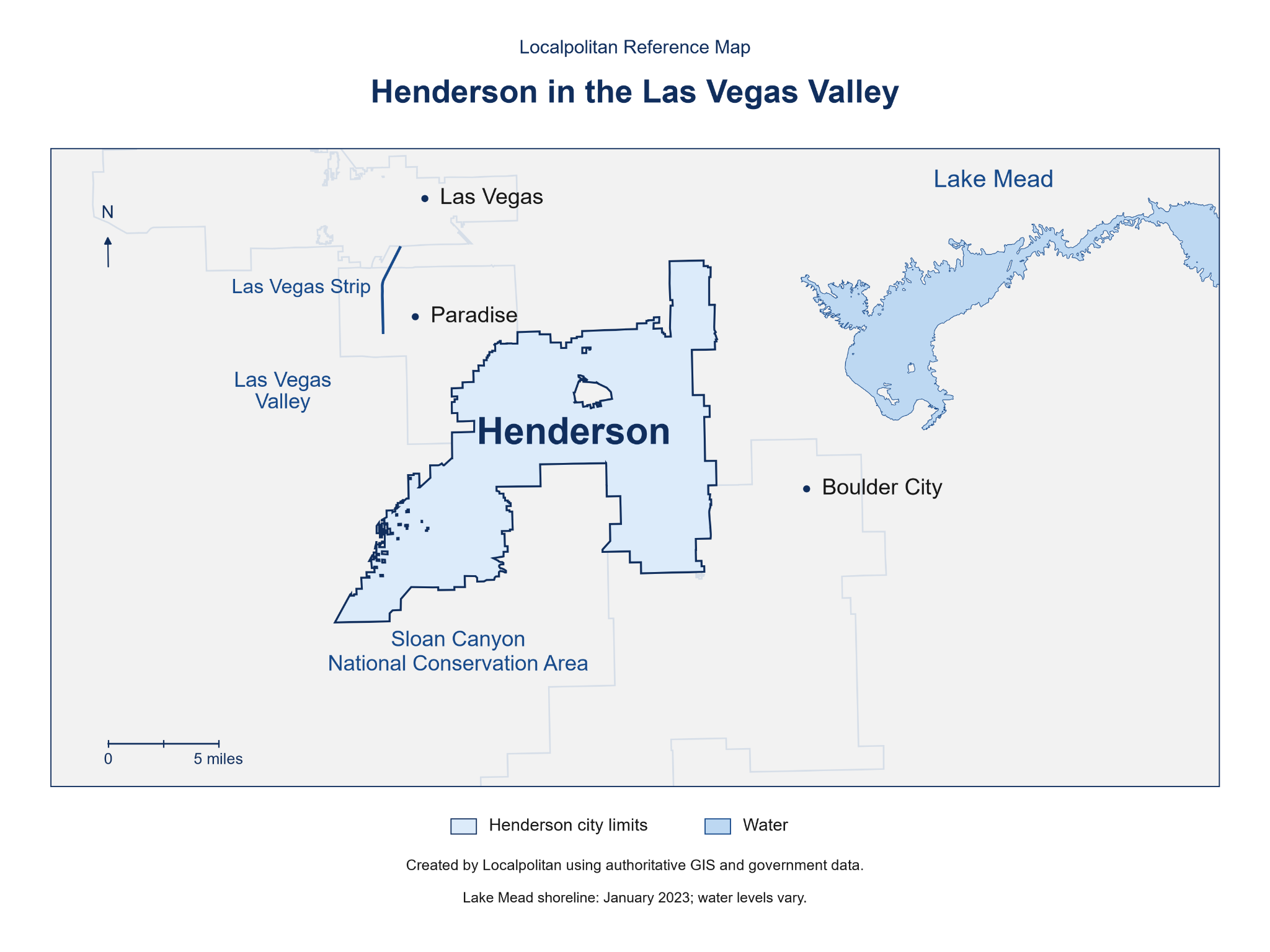
20. Henderson is its own city on the southern side of the Las Vegas Valley
Henderson occupies the southern rim of the Las Vegas Valley, with city limits stretching from areas east of Boulder Highway to just east of Interstate 15. Lake Mead National Recreation Area lies to the east, while Sloan Canyon National Conservation Area borders Henderson to the south.
Although Henderson is part of the larger Las Vegas metropolitan area, it is not a neighborhood or district of Las Vegas. Henderson is a separate incorporated city with its own municipal government and city limits, alongside Las Vegas and North Las Vegas within the broader urban valley.
Henderson Desert, Nature and Outdoor Facts
Henderson sits along the edge of protected desert, volcanic mountains and extensive trail systems. The city’s outdoor landscape includes hundreds of miles of trails, Indigenous rock art at Sloan Canyon and a wilderness area shaped by ancient volcanic activity.
21. Henderson has more than 300 miles of trails
The City of Henderson manages more than 300 miles of trails across the community. Its current parks system also includes 77 parks, eight recreation centers and 105 athletic fields.
The trail system includes urban routes as well as longer desert connections. The River Mountains Loop Trail connects Henderson with Lake Mead and Hoover Dam. The Amargosa Trail links the foothills of the McCullough Range with parks inside Henderson.
22. Sloan Canyon contains more than 300 rock art panels and about 1,700 designs
The Sloan Canyon Petroglyph Site contains more than 300 rock art panels with about 1,700 individual designs. The Bureau of Land Management (BLM) says the designs represent native cultures dating from the Archaic to the historic era.
The site lies within the approximately 57,728-acre Sloan Canyon National Conservation Area, which forms part of the mountainous southern edge of Henderson and the Las Vegas Valley. BLM considers the petroglyph site one of the most significant cultural resources in Southern Nevada.
23. The mountains south of Henderson contain a volcanic wilderness
The North McCullough Wilderness covers about 14,763 acres entirely within Sloan Canyon National Conservation Area. The Bureau of Land Management describes the wilderness as volcanic in origin, with visible lava flows, ash falls and glassy volcanic zones.
The wilderness occupies part of the McCullough Range south of Henderson, where elevations rise to more than 5,000 feet. Its volcanic geology adds another layer to the desert landscape surrounding the city beyond the better-known petroglyph sites.
Henderson Water and Environmental Facts
Water use works differently in a desert city, and Henderson has developed systems that reuse treated wastewater rather than treating it as waste. Those systems also created an unexpected wildlife habitat and help Southern Nevada stretch its Colorado River supply.
24. Henderson’s Bird Viewing Preserve grew out of wastewater ponds
The Henderson Bird Viewing Preserve sits within the city’s Water Reclamation Facility, where wastewater ponds began attracting native and migratory birds decades ago. Birders were visiting the ponds long before Henderson formally developed the area as a preserve in the 1990s.
Today, the preserve covers about 140 acres and includes nine ponds and five miles of trails. More than 270 bird species have been recorded there, including American avocets, which nest at the preserve during summer. The wastewater ponds have become one of the Las Vegas Valley’s notable bird habitats.
25. Henderson reuses about 30% of its reclaimed water locally
Henderson reuses about 30% of its reclaimed water each year for purposes such as irrigating golf courses, a cemetery and Boulder Highway medians. Reclaimed water also supplies the nine ponds at the Henderson Bird Viewing Preserve.
Treated water that is not reused locally can flow through the Las Vegas Wash back to Lake Mead, where it earns Colorado River return-flow credits. Under Southern Nevada’s water accounting system, each gallon returned allows an equivalent gallon to be withdrawn later, as long as Nevada’s net consumptive use remains within its Colorado River allocation. In effect, Henderson uses both direct reuse within the city and indirect reuse through the Colorado River system.
Modern Henderson Facts
Modern Henderson has developed its own sports identity within the Las Vegas Valley. A multipurpose arena in Green Valley hosts several professional teams, while a city BMX track has earned national recognition and has ties to an Olympic champion.
26. Lee’s Family Forum hosts professional hockey, football, lacrosse and volleyball
Lee’s Family Forum opened in Henderson in March 2022 and has a fixed seating capacity of 5,567 for hockey and indoor football. The arena is currently home to the Henderson Silver Knights of the American Hockey League, the Vegas Knight Hawks of the Indoor Football League and the Las Vegas Desert Dogs of the National Lacrosse League.
The Vegas Thrill professional women’s volleyball team paused operations for the 2026 season but announced its return for January 2027. The team will again play at Lee’s Family Forum, giving the Henderson arena professional teams in hockey, indoor football, lacrosse and volleyball.
27. Henderson has a BMX track that was named the fastest in the nation
USA BMX named Whitney Mesa BMX the fastest track in the nation after its Track vs. Track competition at the 2024 USA BMX Grands. The track sits next to Whitney Ranch Recreation Center and had previously been recognized as the top BMX track in Nevada.
Whitney Mesa is also the home track of Henderson resident Connor Fields, a three-time Olympian who won BMX racing gold at the 2016 Rio Olympics. Fields became the first American to win an Olympic gold medal in BMX racing.
Henderson, Nevada Trivia and FAQs
These quick answers cover some of the most common questions about Henderson’s history, location and local identity.
What is Henderson, Nevada known for?
Henderson is known for its World War II magnesium-production history, large master-planned communities, extensive trail system and desert setting on the southern side of the Las Vegas Valley. The city is also home to Water Street, the Henderson Bird Viewing Preserve and nearby Sloan Canyon National Conservation Area.
Is Henderson part of Las Vegas?
Henderson is part of the larger Las Vegas metropolitan area and Las Vegas Valley, but it is not part of the City of Las Vegas. Henderson is a separate incorporated city with its own municipal government and city limits.
What county is Henderson, Nevada in?
Henderson is in Clark County, the same county that includes Las Vegas, North Las Vegas and much of the surrounding Las Vegas Valley.
Who was Henderson, Nevada named after?
Henderson was named after Charles B. Henderson, a former U.S. senator from Nevada. A post office serving the Basic Townsite was named for him in 1944, and the community soon became known as Henderson.
When was Henderson, Nevada founded?
The community that became Henderson began taking shape during World War II, when construction of the Basic Magnesium plant and Basic Townsite brought thousands of workers to Southern Nevada. Henderson officially incorporated on April 16, 1953.
Are there tarantulas in Henderson, Nevada?
Yes. Tarantulas live in the desert around Henderson, including Sloan Canyon. They spend much of the year underground, but male tarantulas become more visible during the fall mating season when they travel in search of females.
Explore More Nevada Resources
- Henderson, Nevada — Explore Henderson’s population, geography, history and place within the Las Vegas Valley.
- Henderson ZIP Codes — See the ZIP codes serving Henderson and the communities and areas associated with them.
- Cities in the Las Vegas Valley — See the incorporated cities and major unincorporated communities that make up the Las Vegas Valley.
- Cities in Clark County, Nevada — Explore Clark County’s incorporated cities and how they fit into the county’s broader geography.
- Southern Nevada Cities — Explore incorporated cities across Southern Nevada and their place within the region.